
The Dentist's Guide to Google Ads in 2026: What Actually Works Now
Google Ads for dentists is changing again in 2026. I break down the Local Services Ads migration into Google Ads, the badge rename, and what is worth ignoring.

Short answer: The 2026 Google Ads changes that matter for dental practices are practical: Local Services Ads start moving into Google Ads in August, and old badge names like Google Screened are retired and should come off your site. Most money still leaks through broad match and thin negative keyword lists, so read your search terms and track to booked appointments, not clicks.
I have been managing Google Ads since 2007. Back then you could put up a basic text ad for a dental practice and get patients for pennies. That is over. If you are still running the strategy that worked for you in 2024, you are probably paying Google for traffic that never sits in a chair.
Most of what gets written about dental marketing right now is noise about features you cannot actually use yet. So here is the practical version: one change that is genuinely coming for your account this year, one that already happened and that most practices have not caught up to, and one that is being oversold.
Local Services Ads are moving into Google Ads
This is the change that matters most, and it is the one I would plan around.
Local Services Ads have always lived on their own platform, separate from Google Ads, with pay-per-lead pricing instead of keyword bidding. Google is now beginning a gradual move of that functionality into Google Ads through a new campaign type built around pay-per-lead goals. The rollout starts in August and is expected to continue into 2027.
The detail worth writing down: existing LSA campaign data is not expected to transfer into Google Ads. If your practice has been running LSAs for years, that history is what makes your cost per lead predictable. Assume you will be rebuilding some of that context rather than inheriting it.
There is also an open question for dental specifically. LSA lead collection happening inside Google raises a HIPAA question that has not been clearly answered yet. I would not rush a dental practice into the new campaign type on day one for that reason alone. Watch it, plan for it, do not volunteer to be the test case.
The badge names changed and your website probably still says the old ones
Google overhauled the Local Services badge system, and the names you have been using are retired. Google Guaranteed, Google Screened, and License Verified no longer exist as badge names, and they should not appear in anything a patient reads.
Go look at your own site. Most dental practices have a trust block on the homepage or the new patient page that still says "Google Screened," often next to a badge image saved years ago. That is now inaccurate on a page whose entire job is establishing credibility. It takes ten minutes to fix and almost nobody has done it.
One related note, and this one is a rule I do not bend: never recreate a Google badge as an image file yourself. Google requires its badges be served from its own source. An approximation is a legal problem, not a design choice.
Business Agent for Leads is real, and you cannot use it
You are going to keep reading about Business Agent for Leads, the format Google announced in May that puts a chat conversation inside the ad instead of a static lead form. A prospect asks a question, gets an answer drawn from the advertiser's own website, and only then gets a pre-filled form.
It is a genuinely interesting format. It is also not available to you. It runs in open beta for United States advertisers, requires AI Max for Search or Performance Max, and Standard Search campaigns are not eligible. Google tested it first in education, automotive, and real estate. Dental is not on that list.
I am including it because you will see it pitched to you, probably by someone selling dental marketing services who is counting on you not checking. When the beta widens, the practices that benefit will be the ones whose websites already answer real patient questions in plain language, because that is the material the agent draws from. That work is worth doing now. Waiting for the format is not.
Where the money actually leaks
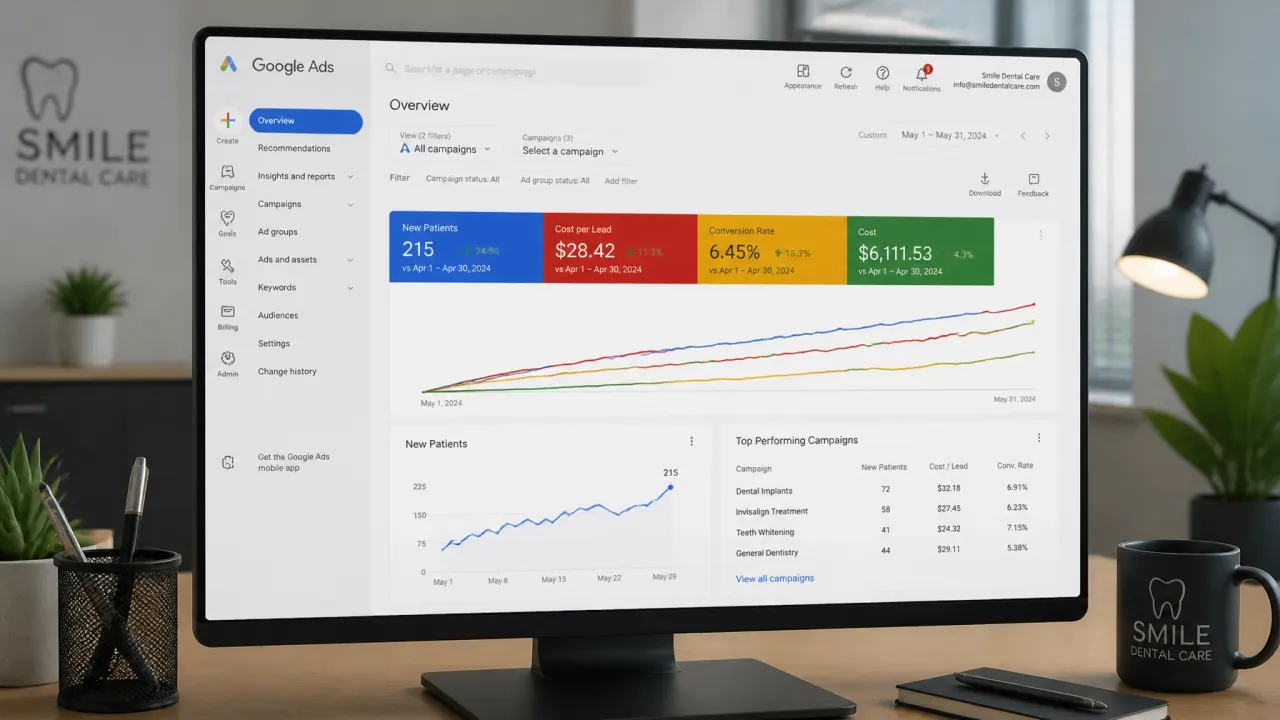
None of the above is where most dental practices lose money. The leak is broad match and a thin negative keyword list.
I see practices spending real money every month while a meaningful share of it goes to searches like "free dental clinic," "dental schools near me," and people researching procedures they have no intention of paying for. Broad match has become considerably more aggressive, and it will find those searches for you whether you want them or not.
If nobody is reading your search terms report regularly, you are paying for that traffic. This is unglamorous, and it is where the return is. Anyone telling you a dental account can be set up and left alone has not run one.
Track to the appointment, not to the click
Most dentists can tell me their conversion count. Very few can tell me which keyword produced a patient who actually showed up.
A phone number click is not a patient. A form fill is not a patient. Until the ad click connects to what happened in your practice management software, you are optimizing toward whichever keyword generates the most cheap noise. That is how a whitening campaign with a great cost per conversion quietly outbids an emergency campaign that is filling your schedule.
Close that loop and the decisions get simple. If teeth whitening generates clicks and no appointments, it goes. If emergency dentist costs more per lead but produces booked treatment, it scales. It is arithmetic. The industry prefers to make it sound like something more.
What I would do this quarter
Update the retired badge language on your site. Pull ninety days of search terms and build the negative list properly. Get conversion tracking connected to something that reflects a real appointment. Then, before August, decide who is responsible for watching the Local Services migration in your account, because it will happen gradually and it will not announce itself.
That list is not exciting. It is what I would do if the account were mine, and I have been doing this since 2007 for everything from local practices to Fortune 500 accounts including CarMax.
Quick Answers
About the Author
Charles Williams
· Founder, High Priority MarketingGoogle Ads Specialist · Managing paid search campaigns since 2007
Charles has been managing Google Ads accounts for local service businesses, home services contractors, and B2B companies since 2007. He has worked with Fortune 500 brands including CarMax, Adobe, and Citrix, and founded High Priority Marketing to give smaller businesses access to that same level of strategic depth without the overhead that drives up costs and slows things down.
highprioritymarketing.com →Find Out Where Your Google Ads Budget Is Leaking
Get a free audit of your Google Ads account. I review it myself and show you exactly where spend is being wasted and what to fix first.
Get Your Free AuditReady to get started?
See the services I offer and how I can help your business grow.