
Google LSA for Plumbing Companies: How It Works and When Search Ads Win
How Google LSA works for plumbing companies: screening, charged leads, ranking, the move into Google Ads, and when search ads win instead.
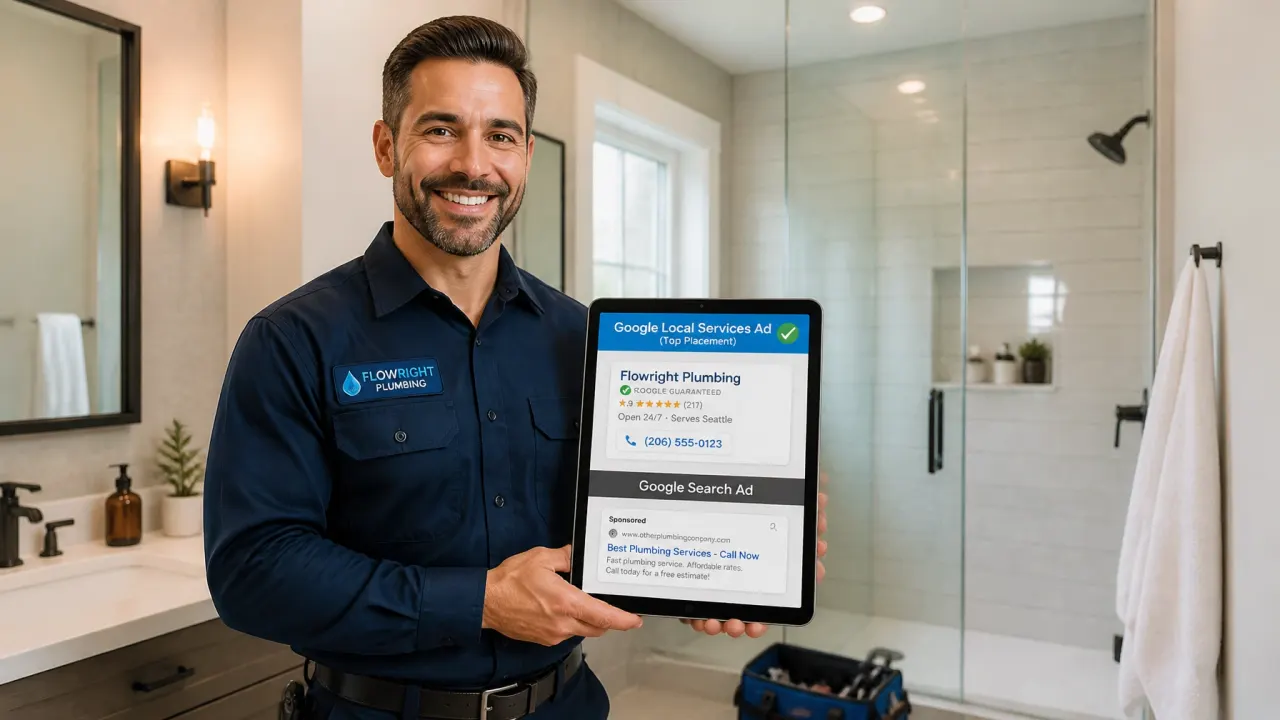
Short answer: Google Local Services Ads (LSA) put a plumbing company at the top of local searches with the Google Verified badge, and you pay for leads such as calls, messages and bookings. You pass Google's screening, pick your job types and service areas, and set a weekly budget. I use LSA for repair and emergency calls and search ads for big jobs like repipes, tankless water heaters and sewer lines.
LSA pays off when the setup matches the work you want: the jobs you pick, how fast you answer, and whether anyone checks the leads Google charges for. This guide covers how LSA works for a plumbing company, what you pay for, what sets your rank, the move into Google Ads that's happening now, and when search ads are the better buy.
How Google LSA Works for Plumbing Companies
1. Pass Google's screening
Before your ad can run, Google screens the business. Google says the screening and verification process varies by category and location, and can include background, business registration, insurance and license checks, plus a minimum number of reviews. Where background checks apply, they cover the business, every owner, and the plumbers who work in customers' homes. Office staff don't need one, and there's no credit check.
Keep your license and insurance certificate current, and make sure the name on the insurance matches the name on your account. Google also re-checks businesses over time. If you skip a requested review, Google says you can lose the badge, have your ads paused, or have the account suspended.
2. Choose your job types and service areas
There are no keywords in LSA. You choose job types and service areas, like drain cleaning, water heater repair or "install shower", and the cities, counties or ZIP codes you serve. Your ad can also show for general searches like "plumber". If you add a city, the ad can show to people in that city and to people elsewhere who search with the city's name.
Be strict here. Google no longer credits leads marked "job type not serviced" or "geo not serviced". If you leave sewer camera work switched on and don't own a camera, those calls are yours to pay for. I select every job a client actually does and only the areas their trucks will drive to.
3. Know what counts as a charged lead
You set an average weekly budget, and Google charges for valid leads. A lead counts when:
- You answer a call, or call the customer back and talk to them.
- You miss a call during your business hours and the caller stays on the line more than 20 seconds.
- The customer texts, emails or leaves a voicemail.
- The customer sends a booking request (US and Canada only).
The missed-call rule is the one that surprises plumbers. If a tech on a job lets the phone ring during business hours, you still pay for that lead. Follow-up calls from the same customer within 15 days aren't charged again. Message leads are usually priced lower than calls. Google screens out spam and duplicates up front, then keeps reviewing charged leads for 30 days and credits low-quality ones on its own. You can also rate each lead, and Google uses that feedback to adjust what it sends you.
4. Know what decides your rank
Google ranks LSA providers in an auction. Its page on LSA ad rankings lists the factors:
- Your bid, the most you'll pay for a lead.
- How likely your ad is to produce a lead. This includes your responsiveness (Google says missed calls can hurt it), the search itself, how relevant your services and business bio are, and whether you accept message and booking leads.
- Profile quality: your rating, number of reviews, average response time, high-quality photos and the verification checks you've completed.
Two of those are fully in your hands: how fast you answer and how many good reviews you collect. Your LSA reviews are managed in Google Business Profile, so the same reviews show on your Maps listing and your ad. Google recommends at least five. Photos of your team, work and equipment help too.

What LSA Leads Cost a Plumber
Google doesn't publish a price list. It says lead prices vary by location, job type, lead type and bidding mode. You pick one of three bid modes:
- Maximize leads: Google sets the bid. Google recommends a budget of at least 10 leads a week.
- Target cost per lead: automated bidding aimed at an average you set.
- Max per lead: manual bidding with a hard cap.
Google says it takes about two weeks for results to settle after a change. I set budgets from each client's own numbers: what a lead costs, how many book, and what the average job is worth. A national average tells you nothing about your town.
For comparison, here's what search ads clicks cost. In October 2026 Keyword Planner data, top of page bids for "plumber near me" ran $12.22 to $82.33, "emergency plumber" $24.42 to $110.00, and "drain cleaning" $4.07 to $51.55. A click isn't a lead, so a search ad needs several clicks to produce one call. That's the main reason LSA often wins on everyday repair work. I break down search click costs further on my Google Ads page for plumbers.
Your LSA Account Is Moving to Google Ads
Google is moving Local Services Ads into Google Ads as Performance Max campaigns with pay-per-lead goals. The first phase began in August 2026 for select US home and storefront service advertisers, and plumbing is on that list. Service-area businesses without a physical storefront follow in late 2026, and the remaining categories in 2027. Most plumbing companies will move in one of the first two phases.
You still pay per lead, the ads stay keywordless, and they show in the same spots on Search and Maps. What changes:
- You manage budgets, targeting and leads inside Google Ads.
- Your old LSA performance reports don't carry over. Download or screenshot them before your move date.
- Manual bidding and industry-level Target CPA are going away.
- Your business name, address and hours sync from Google Business Profile, so fix them there.
Google emails the account admin 14 days before the move. My LSA to Performance Max checklist covers what to check before and after.

LSA or Search Ads: Which Wins for Plumbers?
For emergency and everyday repair calls, LSA usually wins. Someone searching "burst pipe repair" wants a plumber now, the LSA is the first thing they see, and you only pay when they reach you.
For high-ticket work, search ads usually win. A homeowner pricing a whole-house repipe or a tankless water heater compares companies before calling. With search ads you choose the exact searches, write the ad, and send them to a page built for that job.
- LSA pros: pay per lead, top-of-page placement, the Google Verified badge, strong on mobile emergency searches.
- LSA cons: no keyword control, charges for missed calls, rank depends on reviews and response time as much as budget.
- Search ads pros: you pick the searches, the message and the landing page, which suits big-ticket jobs.
- Search ads cons: you pay per click whether or not anyone calls, so the account needs weekly attention.

How I Run LSA for Plumbing Companies
I rarely pick just one. LSA runs all the time for service calls and emergencies. Search ads go after repipes, water heater replacements, water filtration and sewer line work, each with its own landing page.
On the LSA side, I check four things every week:
- Response time. I ask clients to answer every lead within 15 minutes. That's my rule, not Google's. Google may show your average response time on message leads, though, and a homeowner with water on the floor won't wait.
- Charged leads. I read through the leads and rate the bad ones, so Google's credits and lead mix improve.
- Job types and areas. If a job type keeps producing calls the client turns down, it comes off.
- Booked jobs. A lead is a phone call. I match leads to booked jobs so the client knows what each job really cost. Here's how I track plumbing leads from click to booked job.
For after-hours, I turn on message leads. Google says they usually cost less than calls, and they catch the customer who'd rather text at 10 p.m. than wait on hold.
If you already run LSA, search ads or both, the fastest way to see what each lead really costs is a free written audit. I review your LSA settings and leads alongside your search campaigns and tell you where the budget should go. You keep the report either way.
Want a second look? Get a free LSA and Google Ads audit for your plumbing business.
Quick Answers
About the Author
Charles Williams
· Founder, High Priority MarketingGoogle Ads Specialist · Managing paid search campaigns since 2007
Charles has been managing Google Ads accounts for local service businesses, home services contractors, and B2B companies since 2007. He has worked with Fortune 500 brands including CarMax, Adobe, and Citrix, and founded High Priority Marketing to give smaller businesses access to that same level of strategic depth without the overhead that drives up costs and slows things down.
highprioritymarketing.com →Find Out Where Your Google Ads Budget Is Leaking
Get a free audit of your Google Ads account. I review it myself and show you exactly where spend is being wasted and what to fix first.
Get Your Free AuditReady to get started?
See the services I offer and how I can help your business grow.